vRegistry —
digital
phlebology.
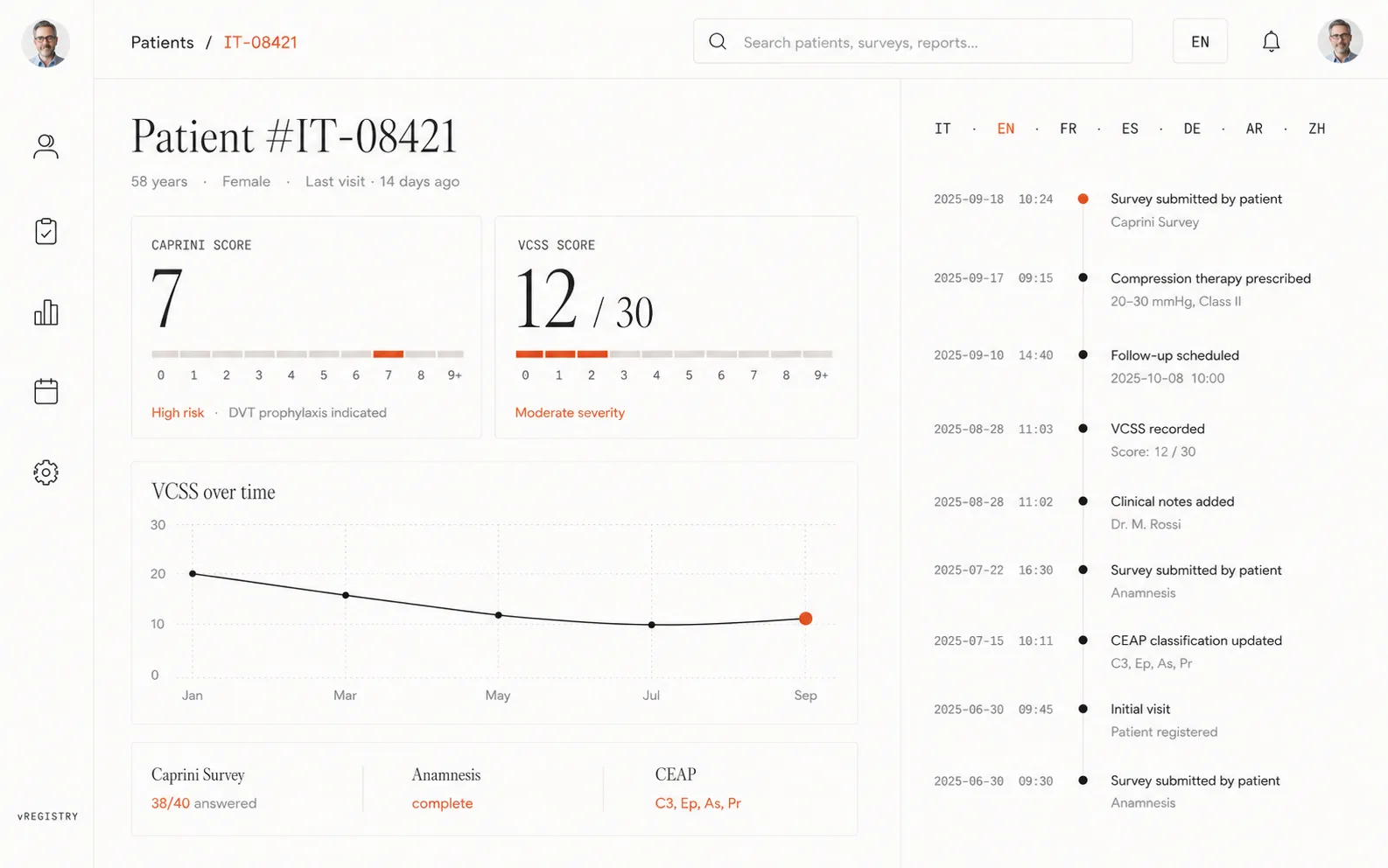
Caprini Survey: a web platform for vascular specialists, phlebologists and lymphologists. Patient records, automated clinical scores, reporting and longitudinal monitoring — in 14 languages.
What is
vRegistry.
A single clinical environment for managing the entire vascular patient journey — from initial intake to the report, all the way to outcome monitoring. Standardizes scores, history-taking and prescriptions, freeing up time from repetitive work.
Where we
started.
Phlebologists and lymphologists manage patient records on paper or in generic software never built for vascular clinics. Caprini, VCSS and Wells scores calculated by hand, clinical manual close at hand. Research data scattered across private practices and hospital centers. Clinical terminology translated by hand for every international congress.
The challenge
Digitize vascular clinical practice with validated scores — Caprini, VCSS, Wells — calculated in real time during the visit. Patient records structured for research, not just for the archive. Support for fourteen languages for international use. Compliance with healthcare data security requirements.
Our approach
Data model structured by clinical domain, scores calculated server-side with coefficient auditing. Clinical strings translated by native-speaking physicians, not by generic translators. Weekly clinical demos with the physicians who use it, every release validated on a real case before going to production.
The result
Vascular clinical practice digitized, scores calculated in seconds instead of minutes with a manual and calculator. A structured, queryable research dataset, ready for multicenter studies. Platform adopted across multiple countries, the same clinical experience in every language.
Three scores,
calculated on the fly.
The reference clinical algorithms for venous risk assessment. The physician enters structured data, the platform calculates the score and classifies risk in real time.
Venous thromboembolic risk
Peri-operative VTE risk stratification. Weighs 40+ factors (age, comorbidities, mobility, clinical history) to guide prophylaxis.
Venous Clinical
Severity Score
Clinical severity of chronic venous disease. 10 clinical attributes, 0–3 each — quantifies the picture and tracks its evolution over time.
Clinical DVT probability
Pre-test probability of deep vein thrombosis. Guides second-level test requests while avoiding unnecessary exams.
Key
features.
Four main areas of the platform. Each area covers one block of the clinical journey, from patient arrival to follow-up.
Patient
record
Demographics, history, comorbidities, family history and lifestyle. A single source of truth for longitudinal follow-up.
Structured
visit
CEAP classification, refluxing segments, symptoms, signs, compression prescriptions, veno-active drugs, procedural indication.
Dynamic
surveys
Customizable questionnaires with configurable questions. Structured results collection, reusable across visits.
Reports
& exports
Visit data extraction (full-doctor-reports), signable PDF reports, exports for clinical analysis and follow-up.
Domains
managed.
Twelve Prisma aggregates covering the vascular clinical domain. All under iron-session authentication with signup, email activation and password recovery.
Fourteen
languages, one platform.
Native internationalization via next-intl. App Router routing serves the localized version under /[locale] — clinical content is translated, scores stay universal.
Technical
features.
Decisions that protect clinical data and the physician's time: server components for heavy queries, stateless encrypted sessions, locale-aware routing from the ground up.
Tech
stack.
Next.js 14 with App Router, PrimeReact for the clinical UI, Prisma on PostgreSQL for the data model, next-intl for the 14 languages, iron-session for authentication.
Standardizes what the physician repeats, frees up time for the clinic.